You just have to go on when it is worst and most helpless -there is only one thing to do with a novel [or anything important**] and that is go straight on through to the end of the damn thing.
Ernest Hemingway to F. Scott Fitzgerald in a 1929 letter from France, courtesy the New York Times archive
Hemingway and Fitzgerald in Paris, 1925, courtesy Brainpickings (lord only knows where she got it from)
#alonetogetherwiththelostgeneration
*Even though it says Straight On Through and not Break On Through, I wonder how many first thought of the Doors…
When I was a kid a buddy of mine would occasionally drag me along to a Catholic church service with him, seeing how misery loves company, especially as a child. Even though I hadn’t a clue what was going on — being raised Protestant — I was always mesmerized by the outlandish garb, the thick incense, and especially the incomprehensible Latin that still kind of seemed to make sense. It all seemed so surreal, so magical.
I’m not m much of a church-goer, but I’ve never had that wondrous feeling at a Protestant service and I guess deep down I’ve always wished I had.
Perhaps if I had, I would have gone more to church.
Perhaps not.
More and more young Christians, disillusioned by the political binaries, economic uncertainties and spiritual emptiness that have come to define modern America, are finding solace in a decidedly anti-modern vision of faith. As the coronavirus and the subsequent lockdowns throw the failures of the current social order into stark relief, old forms of religiosity offer a glimpse of the transcendent beyond the present.
From The Future of Christianity Is Punk, New York Times, May 8, 2020
How long, you simpletons, will you insist on being simpleminded? How long will you mockers relish your mocking? How long will you fools hate knowledge?
It’s a close call but this might be one of those rare instances where the movie outperforms the book. The flick does have an unfair advantage though with Bogart as the lead…
Even trying to categorize “In a Lonely Place” is tricky: It has elements of murder mystery, melodrama and Hollywood insider scoop. Yet it is certainly one of the most forthright films to deal with domestic abuse ever to come from a major production company, let alone in the early 1950s. Here is a movie so rough-minded, so willing to be unsympathetic that it opens with its protagonist, a screenwriter named Dixon Steele (Humphrey Bogart), threatening to get into a brawl with a stranger.
New York Times , April 30, 2020
THE BOGART SUSPENSE PICTURE WITH THE SURPRISE FINISH – (original tag line)
A classic California noir with a feminist twist, this prescient 1947 novel exposed misogyny in post-World War II American society, making it far ahead of its time. [Amazon Publisher description]
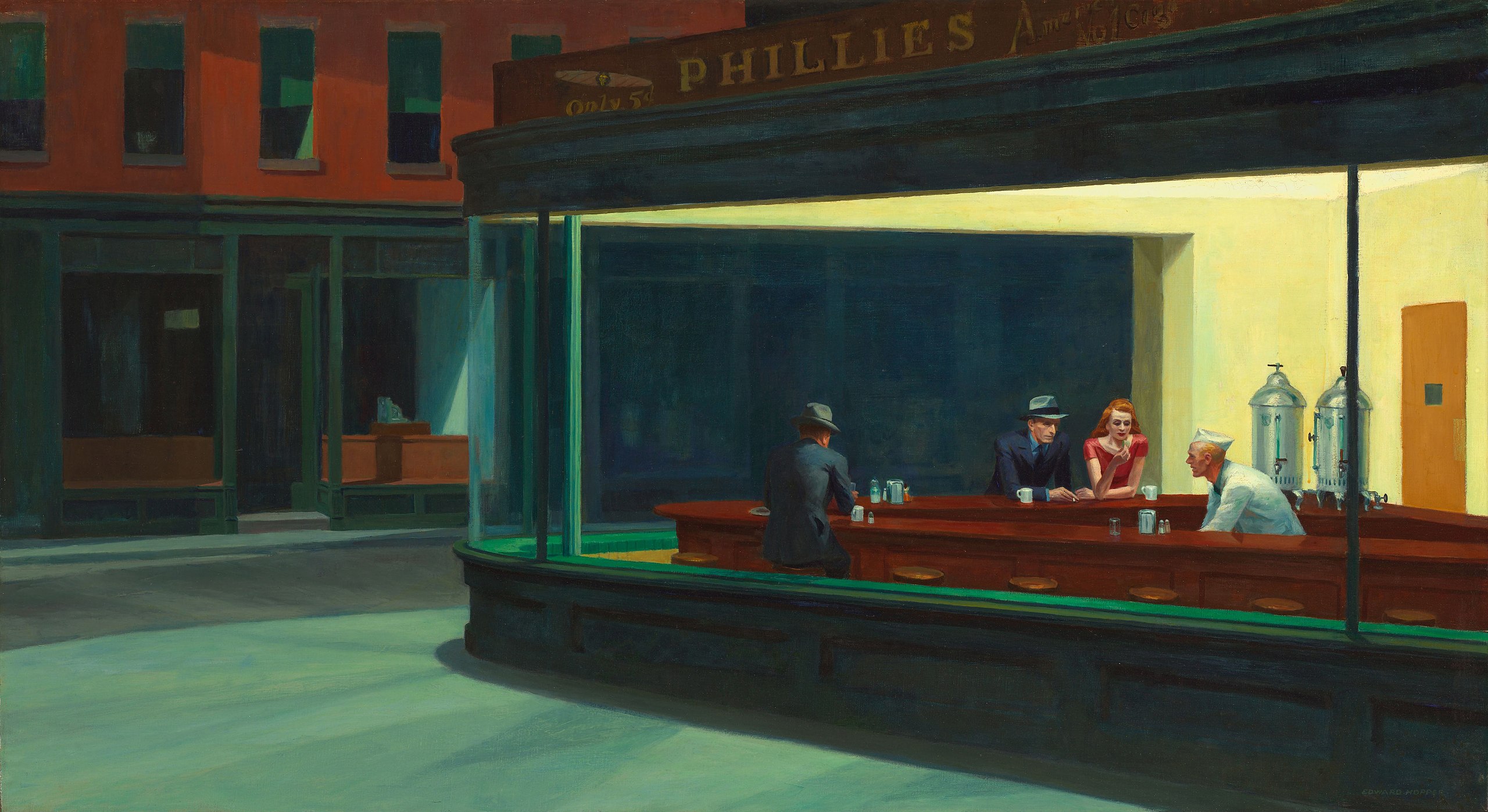
Be it be an exploration of loneliness or light or whatever, but ”Nighthawks,” to me, is the most colorful expression of the beautiful bleakness of noir that I know…
But while some Hopper experts appreciate the wave of [social media] interest in the American painter, who died in 1967, they say it’s a mistake to brand him as a patron saint of loneliness and social isolation.”
The New York Times’ recent piece Melville’s Whale Was a Warning We Failed to Heed is actually a quite serious look at human nature, racism, the environment… but here is a fun selection from it that belies its erudition:
Melville had read Jeremiah Reynolds’s violent account of a sperm whale “white as wool,” named — for his haunt near Mocha Island, off the coast of Chile — Mocha Dick. It’s unknown what led Melville to tweak Mocha to “Moby.” Good thing he did, and that Starbuck was the name he gave his first mate rather than his captain. Otherwise the novel would follow Starbuck’s obsession with a Mocha.
“The takeaway from all [the studies] is that no matter the culture, humans are intimately attached to stories. They’re part of our makeup as a species. Stories can literally transport us into the mind and body of a character. They can move us toward empathy or action. Nothing has the power to inform, change our minds, unlock our potential, or transform us and our society in the most powerful and profound ways. Now, we’re starting to unlock the neuroscience behind this and learn exactly how they impact us.”
If this is true, that what we read deeply shapes who we are, and my common sense detector, aka my gut, tells me it is, then in a nation where reading for personal interest has been in steady decline since 1978, we’re in big trouble.
But it certainly goes a long way in explaining our national empathy deficit…